 Rui Carmo
This was a shorter work week partly due to the Easter weekend and partly because I book-ended it with a couple of days off in an attempt to restore personal sanity–only to catch a cold and remain stuck at home.
In practice that meant I spent most of it hacking on things I’ve been putting off for weeks, and after we finally made it to the countryside, the weather was nice enough to spend most of my time lounging about with nothing but my phone and the Xteink X4–which is about as close to a holiday as I’m going to get this quarter.
I’m also partway through Patrick McGee’s Apple in China, which is one of those books that makes you want to check the news every few pages to see if anything has changed since the last chapter. The thesis–that Apple’s dependence on Chinese manufacturing is a strategic vulnerability that could be exploited overnight–has already become obvious thanks to last year’s geopolitical upheaval, but McGee’s sourcing and detail make it feel much more concrete than the usual hand-wringing.
Very nice reading, especially if you had anything to do with Nokia and phone logistics.
The Xteink X4
I wrote this up separately, but the short version: it’s an absurdly small e-ink reader that costs almost nothing, feels better made than it has any right to, and reminds me of reading e-books on a Palm PDA. No front light, which limits it to daylight and decently lit rooms, but for the price and the form factor I’m not complaining. I’ve been carrying it around all weekend and it’s a genuinely pleasant little device.
Piclaw
I had a slight whoopsie in my Proxmox cluster (lite LVM doesn’t fully isolate volumes, so one of my new machines corrupted another two…), and Piclaw helped me fix everything and restore from backups with nothing but raw API calls to the cluster. That was enough motivation to make things official and add SSH, Proxmox and Portainer tooling, all lazy-loaded to save LLM context.
I now have a fourth instance running on my network that can discover, inspect and manage VMs and containers across the cluster without helper scripts, which is pretty neat. I’ll be rebuilding my GPU sandbox with it in a couple of days, and have it update my Obsidian notes directly.
That ARM SBC, and the BasiliskII JIT
I spent a good chunk of this weekend working on finishing that review I’ve been going on about for weeks. Since I have a Piclaw instance on it, I asked it to update benchmark data, charts and diagrams remotely, and revise my notes on the entire thing (GRUB, resize-filesystem bugs, three rounds of reboot-fallback patches).
But last week I was using it to work on an AArch64 JIT for BasiliskII, and it’s tantalisingly close to done. The bringup consumed most of my evenings, ranging from byte-order bugs–graphics corruption, palette rendering, JIT dispatch–to a steady stream of fixes to the original JIT source, with every emulated instruction block exposing a new flag-handling bug.
This is the sort of work I would never have been able to do without AI. I do have a background in 68k assembly (and a shelf of ancient books), but things like register mapping and memory alignment fixes would have gone right past me. And yet, neither Codex nor Claude were able to see the big picture–like realising that IRQs were messing with JIT state and needed proper handling:
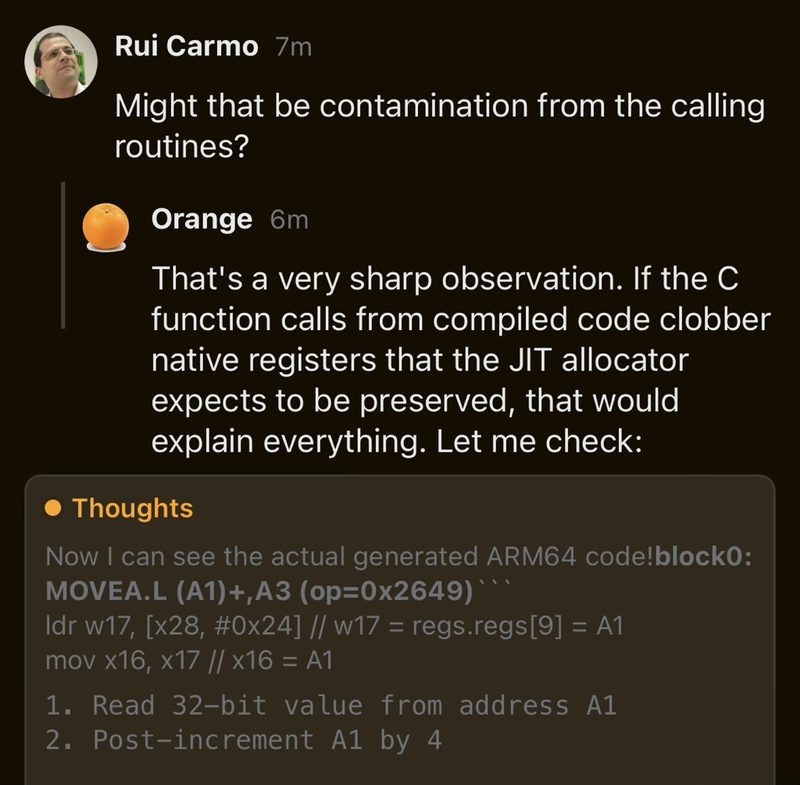
The X flag (extend/carry) was the recurring villain–the models found bugs in how it was copied, masked and converted between the interpreter’s format and the JIT’s native representation. A wrong bit position in DUPLICATE_CARRY, COPY_CARRY not masking to the carry bit, LSL missing from legacy_copy_carry_to_flagx, and a countdown variable type mismatch that broke tick synchronisation. All individually plausible, collectively maddening until you realise it was polluted by both IRQ handling and state tracking whenever you jumped out of the JIT.
Another great thing about AI is effortless documentation: a comprehensive bringup document now lives in the repo tracking the bugs found so far, and it’s easy to trim out the fluff and keep things factual.
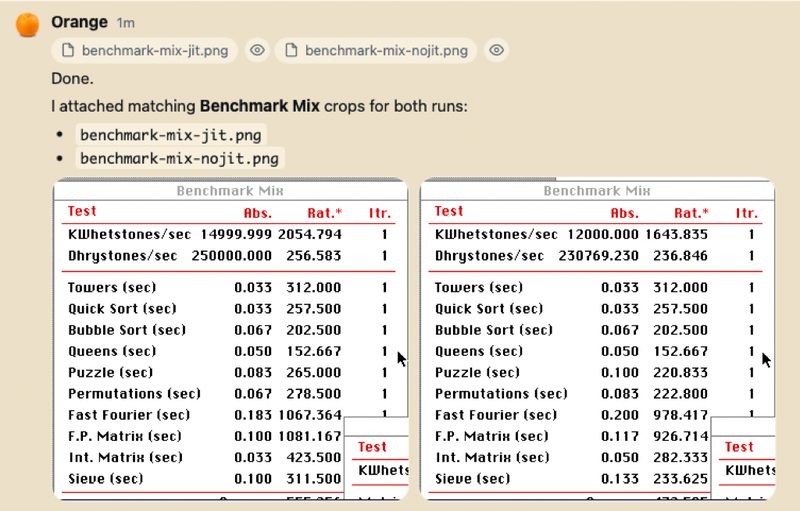
Right now the JIT boots to a Mac OS desktop with basic optimisations, but full JIT is still a work in progress. However, even the partial speedups are already a bit beyond what Classic benchmarking tools can handle, which is rather fun:
With any luck, I should get this working reproducibly in another week or so.